Senin, November 01, 2010

Thai Starts Testing Chaiseri 4x4 Tactical Vehicle

First Win 4x4 (all photos : TAF)

First Win as Chaiseri 4x4 tactical vehicle was first introduced to the public on Defense & Security 2009 event.

Research and development funded by the company, now the vehicle began to undergo tests by the Thai army.


Tests conducted on actual terrain in Kanchanaburi.

Sabtu, Oktober 30, 2010

Malaysia Will Make Six Littoral Combat Ship in The Next 10 Years

The Malaysian Inshore Patrol Vessels or batch Littoral Combat Ship program

Kuala Lumpur: Malaysian government announced that it will build the new six coastal patrol boats in the 2011-2015 period.

Malaysian Ministry of Defence in the House of Lords yesterday to answer questions raised by Tunku Abdul Aziz, said that the Ministry has been under the 10th Malaysia Plan to include the first two batches of coastal patrol ship construction program.

"Department of Defense plans to Po, the actual (Boustead) construction of a further six shipyards, the construction period will last until the 11th Malaysia Plan. The new ships will have a three-dimensional combat capability."

Department of Defense announced the consolidation of the Po, the actual shipyards continue to be a coastal patrol vessel contractor status. The first two batches of inshore patrol vessels, or now renamed the construction of Littoral Combat Ship program, Defense Department did not give any explanation, but said the new ship will have 3D capability.


Germany TKMS Malaysia next generation combat ship design called "MEKO 100 patrol frigate" (photo : KLSReview)

In addition, Germany and Turkey Shipbuilding in LIMA 2009 to present the Malaysian government during the first two batches of the new inshore patrol vessel program, the Littoral combat ship will use the technology in Germany or Turkey, but also to be explored.

In addition, the Defense Ministry said that according to the Government in 1995 and "cooperation Penang Shipbuilding - Naval Dockyard" (PSC-ND), or now known as Po, the actual Naval Shipyard (BNS), signed the memorandum, the authorities hope that the company commissioned the construction of 27 navy patrol vessels.

"The number 27 is considered the navy to patrol over to the Malaysian maritime enforcement agencies (MMEA) and the upcoming annual session in 2015, age 45 years, the fast attack submarine ship factors."

Ministry of Defence said today, the number 27 is still valid, but ultimately depends on the number of warships in the construction of the Government of Malaysia for each 5-year plan to develop the budget allocation.

Thai Offshore Patrol Vessel Takes Shape

Thai's new design OPV

Bangkok, Thailand: Construction of the first BAE Systems designed Offshore Patrol Vessel for the Royal Thai Navy is now well underway in Thailand, as demonstrated this week at a formal keel laying ceremony at Bangkok Dock, the Company’s local partner.

The occasion, attended by Thailand's Royal representative, HRH Princess Maha Chakri Sirindhorn and senior officials from the Royal Thai Navy, comes just 14 months after the initial contract was signed.

Under the agreement, BAE Systems supplied the design of its proven 90 metre Offshore Patrol Vessel, which Bangkok Dock has adapted to meet the specific requirements of the Royal Thai Navy, for example incorporating a similar combat system to that being fitted to other ships in its fleet. Engineers from BAE Systems are working alongside Bangkok Dock, throughout the construction of the vessel to transfer design knowledge, technology and skills that will contribute to the growth of a sustainable shipbuilding capability in Thailand.

Commenting on the programme, Alan Johnston, Managing Director of BAE Systems’ Surface Ships division, said: “At a time when we are seeking to boost exports, this approach to industry partnerships shows the strength that BAE Systems can bring to navies around the world as they look for cost-effective solutions to enhance the capability of their fleets to meet future requirements.”

Captain Chumpol Promprasit, managing director of Bangkok Dock, said: “To promote a domestic shipbuilding industry, the Royal Thai Navy assigned Bangkok Dock to undertake the provision of design and supply of ship build material using both domestic and international experts during construction of the Offshore Patrol Vessel.

“This is considered as promoting and improving the technical competency and potential of the Royal Thai Navy personnel in building ships for domestic purposes, based on the King’s self sustainability programme.

”The multi-mission Offshore Patrol Vessel will be used by the Royal Thai Navy to primarily be used for Economic Exclusion Zone roles, including routine patrols and border controls. It will also undertake fishery protection tasks as well as protection of natural resources in the Gulf of Thailand and the Andaman Sea and disaster relief.

The BAE Systems designed 90 metre Offshore Patrol Vessel being built by Bangkok Dock for the Royal Thai Navy is the same core platform design as the ships that BAE Systems is building in the UK for the Trinidad & Tobago Coast Guard. The platform is based on the design for the smaller River Class vessels used by the UK Royal Navy and is a highly capable vessel that is attractive to the export market.

As the company continues to expand its international maritime footprint, there are ongoing discussions with prospective customers and partners in a number of markets, including South America and India.

SGPV-LCS Will Be Larger Than Kedah Class

Second generation patrol vessels of Malaysia

Malaysia approaches Boustead for six new patrol

Boustead Naval Shipyard has received a letter of intent from Malaysia's Ministry of Defence to undertake the construction of six Second Generation Patrol Vessels (SGPV) with combatant capabilities.

The value and duration of the project are to be negotiated with the government, parent company Boustead Heavy Industries announced in a filing to the Malaysian Securities Exchange on 18 October.

The SGPV will be a larger and more heavily armed follow-on to the Kedah-class corvettes built for the Royal Malaysian Navy (RMN) under the Next Generation Patrol Vessel programme, although the final design and equipment fit has yet to be finalised.

The SGPV specification calls for a length overall of 99.5 m and displacement of 2,200 tons (full load) in comparison with Kedah-class figures of 91.1 m and 1,650 tons.

Several foreign shipbuilders have submitted proposals based on existing designs that would be modified to fit the Malaysian requirement. BAE Systems is offering a larger version of its 90 m offshore patrol vessel (OPV), Damen Schelde has proposed its SIGMA design, DCNS its Gowind family, Navantia the Caribe-class OPV it is building for Venezuela and ThyssenKrupp Marine Systems its K130 corvette.

Several United States-based companies, including Raytheon, are competing for the SGPV's combat and weapon system. The new ship will have anti-surface, anti-air and anti-submarine warfare capabilities and Malaysia has indicated that the combat and weapon systems will be selected separately from the ship design.The government has also stated that all ships should be built by Boustead, although most of the companies that have submitted proposals have called for the first hull to be built in the home country followed by the remaining five in Malaysia. The matter is currently under review.

The SGPV programme is regarded as crucial by the RMN, particularly following the cancellation of a second batch of Lekiu-class frigates. This has led to concern within the RMN that it will lack combat-ship capability in any territorial dispute over the Spratly Islands in the South China Sea.

However, the commitment to the SGPV is likely to mean that the Malaysian requirement for a multi-purpose support ship is to be deferred for the time being. RMN sources have stated that funding will only be provided for one ship procurement programme, with the SGPV getting priority despite the RMN's loss of a significant portion of its amphibious and transport capability with the destruction of the landing ship KD Sri Inderapura by fire in October 2009.The SGPV has been given priority owing to the fact that Boustead Naval Shipyard will have no further major shipbuilding work when the final Kedah-class corvette is completed this year.

Upgraded Hercules Return to Base

The flight deck of the newly upgraded Hercules

The Royal New Zealand Air Force today welcomed the return of the first of its C-130 Hercules aircraft to have undergone the Life Extension Programme (LEP).

During a short ceremony at Air Force Base Auckland, the aircraft was provisionally accepted by the Air Force from the Ministry of Defence, to commence Operational Testing and Evaluation (OT&E).

This enables the crews to develop and exploit the capabilities of the new systems leading to optimal use of the aircraft when tasked to support government requirements.

Air Component Commander, Air Commodore Steve Moore, who is responsible for the RNZAF’s operational taskings, said the upgraded Hercules is one of the most comprehensive C-130 upgrades ever carried out.

“The Air Force’s five C-130 Hercules are undergoing an upgrade that includes a new glass cockpit, upgraded navigational capability, an advanced communication suite, a centre wing refurbishment, a new self protection suite and replacement of 98 percent of its original wiring. The upgrades will enhance the ability to meet the varied and demanding tasks required of the aircraft.

“The Air Force is looking forward to commencing OT&E to optimise how our crews operate what is a significantly upgraded aircraft. Many elements of the upgrade will inherently improve reliability and availability of the C-130 Hercules fleet. It is an exciting time for the RNZAF with new and upgraded aircraft coming on board.

“No. 40 Squadron who operates the C-130s, will be able to utilise the aircraft in the many roles undertaken for the government and New Zealand, including tactical air transport, disaster relief and civil defence support, aeromedical transport and support to the New Zealand Antarctic programme,“ said Air Commodore Steve Moore.

Part of the upgraded Hercules package is the C-130 LEP Part Task Trainer (like a flight simulator) which electronically emulates the aircraft systems and thus represents a significant technological leap in terms of training for aircrew.

An upcoming Joint Exercise Between Seaborne Troops Takes Chinese and Thai Military Ties to Another Level

STRAIGHT AS A DYE: A Chinese-made C-801 guided missile is test-fired from the Thai warship ‘Sai Buri’, marking the end of a major naval defence exercise in the Gulf of Thailand.

Starting Tuesday and running to Nov 14, the Marine Corps of the Chinese People's Liberation Army (PLA) will conduct joint drills with their Thai counterparts in Sattahip.

Sino-Thai military ties have steadily improved in recent years, especially between the two armies and navies, and which will also see ties extended between the two air forces in the near future. This has been thanks to Thailand's hedging strategy of maintaining its traditionally close relationship with the US while increasing defence ties with China in support of Beijing's grand plan to secure safe passage at sea.

Dubbed "Blue Assault-2010", the joint training exercise in Chon Buri province will be the first time Chinese marines will have conducted drills with marines from another country, the Chinese National Defence Ministry said, according to a report by the official Xinhua news agency.

The joint drill will focus on anti-terrorism and help the two marine corps learn from each other,
enhance mutual understanding and build friendly exchanges and cooperation in a bid to improve the capabilities of both countries' seaborne troops in handling new challenges and threats together, the report said.

SHOW OF STRENGTH: A Chinese fleet is assembled off the eastern port city of Qingdao just weeks after tensions flared following a naval stand-off with the US in the South China Sea. (photo : Bangkok Post)

The exercise will be held just 11 days after the end of a 15-day counter-terrorism training exercise between Thai and Chinese Special Forces in Guilin in the Guangxi Zhuang autonomous region.
The two armies have been holding annual joint Special Forces exercises since 2007.

Japan's Kyodo news service has also reported that 135 marines from each country will take part in the upcoming 20-day exercise that will include basic and comprehensive training scenarios on land, at sea and in the air.

The first naval exercise between China and Thailand took place in December 2005 in the Gulf of Thailand and was called "China-Thailand Friendship 2005". This exercise featured the People's Liberation Army Navy's guided-missile destroyer Shenzhen and supply ship Weishanhu as well as the Royal Thai Navy frigate Chao Praya.

This was the first exercise China had conducted with a Southeast Asian navy, though similar exercises were conducted with the Pakistani Navy in October 2003 and the Indian Navy in November 2003.

Ties between the two armed forces were widened during the Thaksin administration, thanks to General Chavalit Yongchaiyudh's established links with the Chinese leadership, and the integrated economic ties between the two nations.

Military cooperation between Thailand and China actually goes back a bit further to Vietnam's December 1978 invasion of Cambodia. Here Thailand became a supply route for Chinese-made military equipment to Khmer Rouge guerillas fighting the Vietnamese invaders. Clashes between Vietnamese troops and the Thai military as a result also saw Chinese pressure being put on Hanoi with cross-border shelling into Vietnam by the PLA.

Over the past few decades, China has also supplied Thailand with weaponry at knock-down, "friendship prices". In 1987, Thailand became the first Asean country to purchase arms from China and included 400 armoured personnel carriers (APCs), 50-60 tanks and anti-aircraft guns.


A couple of years later the Thailand ordered four Jianghu-class frigates (Bangpakorn, Chao Praya, Kraburi, and Sai buri) and two larger vessels of the same class (Naresuan and Taksin), which were delivered in the early 1990s and still form the bulk of the Royal Thai Navy's fleet.

The patrol boats Pattani and Narathiwat were also built by China.

However, Thai purchases of Chinese military equipment during the 1980s were as much for political reasons as military ones, according to Dr Ian Storey from the Institute of Southeast Asian Studies in a 2008 article titled: China and Thailand: Enhancing Military-Security Ties in the 21st Century published in the Jamestown Foundation's China Brief. Throughout this period Thailand still looked to the US for its most technologically sophisticated weaponry, such as the F-16 fighter, he said.
The close military ties with the US prompted president George W. Bush to declare Thailand a Major Non-Nato ally in October 2003.
A large proportion of China's oil imports cross both waterways and Chinese naval vessels have recently been involved in anti-piracy patrols off the Somali coast, their most distant operational commitment to date, said Mr Davis.

China's growing focus on the South China Sea and Indian Ocean theatre has involved both naval cooperation with, and the building or upgrading of ports in friendly countries such as Cambodia, Burma, Bangladesh and Pakistan. China is also increasing its engagement at a range of levels with Sri Lanka, added the analyst.

"Sino-Thai military exchanges have been gathering pace over the past decade, so there is nothing radically new here. But the closer cooperation between the two navies will certainly be something that Thailand's traditional big-power ally, the US, will be monitoring closely along with other states in Asean and beyond," said Mr Davis.

India, he said, was particularly watching the extension of Chinese naval power into its Indian Ocean 'backyard' with close attention.

Khien Thiravit, Chulalongkorn University's professor emeritus on political science, said closer military ties between China and Thailand should be welcomed as Bangkok already has established relations with the US.

But Mr Khien, a China expert, said he would like to see, at the same time, warmer and more constructive collaboration between Thailand and her neighbours in the region: "If the military leaders of each country know each other well, this region and the world should be at least be more secure with sensible channel of communications. But this can only happen when the politicians also establish constructive and respectful dialogue with each other as well."

Holding joint military exercises are theoretically a sovereign issue of any nation, but Thailand should also exert some diplomatic finesse to secure the support and understanding of neighbours and allies when it holds them, he noted. In light of China's soft diplomacy, he also urged the Thai government to craft well-calculated policy platforms that can best fit the national interest.

Australia to Procure 17 SM-2 Block IIIB Standard

Concept of operation SM-2 block III

WASHINGTON, – The Defense Security Cooperation Agency notified Congress today of a possible Foreign Military Sale to the Government of Australia of 17 SM-2 Block IIIB STANDARD Warhead Compatible Telemetry missiles and associated equipment, parts, training and logistical support for an estimated cost of $46 million.

The Government of Australia has requested a possible sale of 17 SM-2 Block IIIB STANDARD Warhead Compatible Telemetry missiles, including AN/DKT-71 Telemeters and assembly kits, spare and repair parts, technical data and publications, personnel training and training equipment, U.S. government and contractor engineering, technical and logistics support services, and other related elements of logistics support. The estimated cost is $46 million.

Australia is one of our most important allies in the Western Pacific and contributes significantly to ensuring peace and economic stability in the region. Australia’s efforts in peacekeeping and humanitarian operations in Iraq and in Afghanistan have served U.S. national security interests. This proposed sale is consistent with those objectives and facilitates burden sharing with our allies.

The proposed sale of SM-2 Block IIIB STANDARD missiles will be used for anti-air warfare test firings during Combat Systems Ship Qualification Trials for the Royal Australian Navy’s three new Air Warfare Destroyers, currently under construction. Australia, which has already integrated the SM-2 Block IIIA, will have no difficulty absorbing these missiles into its armed forces.

The proposed sale of this equipment and support will not alter the basic military balance in the region.

The prime contractors will be Raytheon Missile Systems Company in Tucson, Arizona, The Raytheon Company in Camden, Arkansas. There are no known offset agreements proposed in connection with this potential sale.
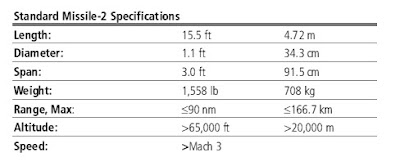
SM-2 block III specification (image : Raytheon)

Implementation of this proposed sale will not require the assignment of U.S. Government or contractor representatives to Australia.

There will be no adverse impact on U.S. defense readiness as a result of this proposed sale.
This notice of a potential sale is required by law and does not mean the sale has been concluded.